Jaguar announced the XK140 at the London Motor Show in October 1954, six years after the XK120 had made the company's name. It kept the 3,442 cc twin-overhead-camshaft six of 83 by 106 mm, and it kept the Moss four-speed gearbox with synchromesh on the top three ratios only. Almost everything else moved on.
The change an owner names first is the steering. The XK120's Burman recirculating-ball box gave way to rack and pinion, and the difference in precision is the single largest improvement between the two cars.
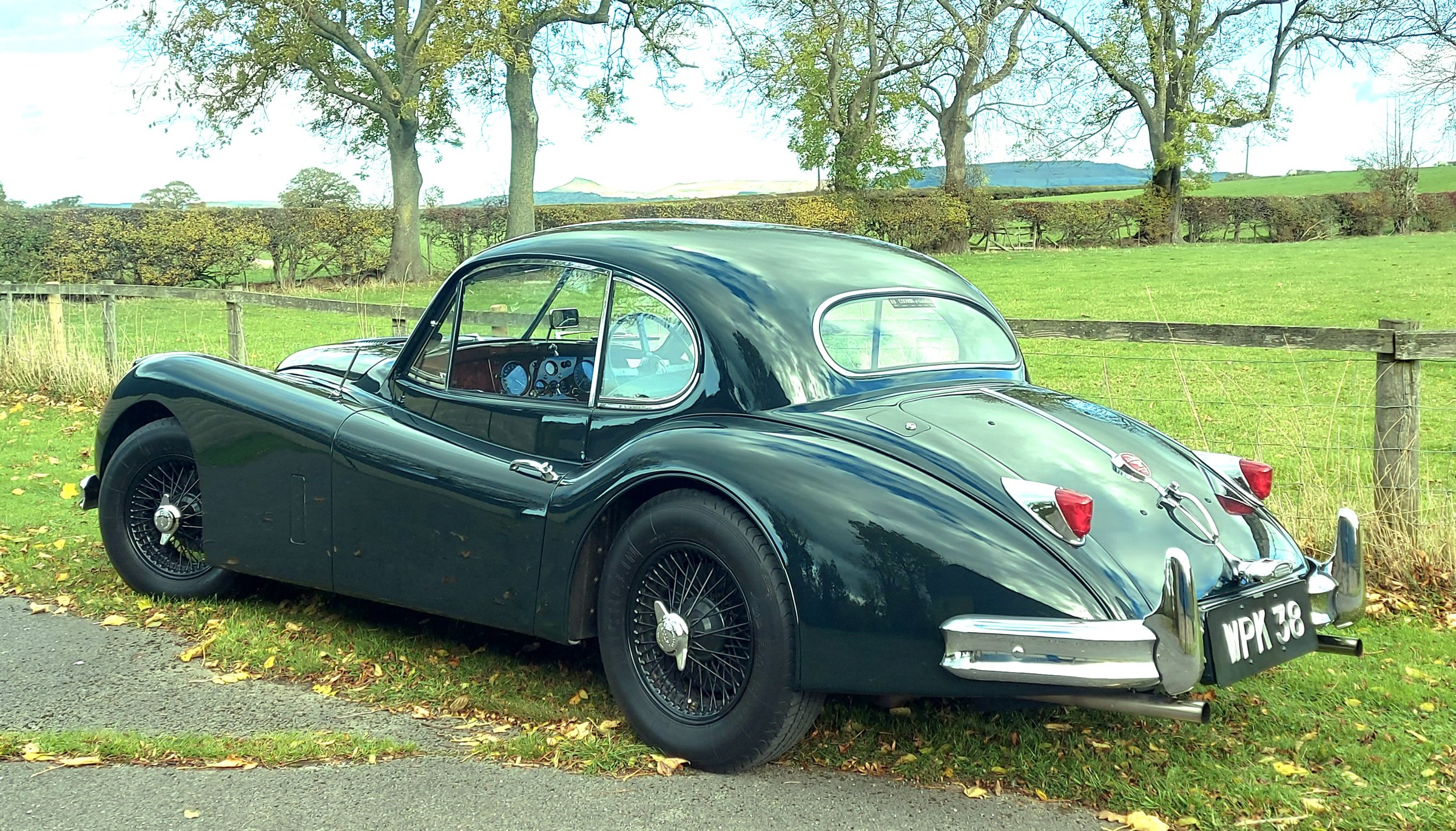
The second is space. The engine, bulkhead and dash all moved forward, which gave three inches more legroom — enough for the closed cars to carry occasional rear seats and for every car to have a cockpit an adult can settle into. Bob Exelby, who owns the car this archive is built around, tried an XK120 coupe before buying his 140 and found at five foot nine that the wheel sat in his lap.
Power went from 160 bhp to 190 as standard, with 210 available from the C-type cylinder head. Telescopic dampers replaced the lever-arm type at the rear, the front already being telescopic, the torsion bars were stiffened, the bumpers became full-width bumpers with overriders, in place of the XK120's small separate bumperettes, and overdrive appeared on the options list — with a Borg-Warner automatic following in 1956, the first ever offered on a Jaguar sports car.
The XK140 was replaced in May 1957 by the XK150, which brought four-wheel disc brakes. Every XK140 ever built left the factory on drums.