Why it came apart
The trigger was not rust. It was the colour.
While I could live with the rattly smoky leaky engine for a while longer, it was the colour of the car that rankled every time I opened the garage door. Originally a standard British racing green, I had chosen what I thought was a slightly lighter version only to find that when it appeared from the spray shop it was what a friend termed 'drab military olive'. It turned out that it was pretty close to 'Harrod's green' as that was the colour of the London department stores delivery vans — and it was entirely my fault as I had provided the paint shop with the colour code.
A rusty patch on the passenger side A-post settled it, along with tired door hinges that could only properly be reached by removing the lower rear section of the front wings.
Body off
The body came off on a Unistrut frame built to allow access underneath while keeping the shell rigid, and went away for media blasting.
On its return, 95% of the body came back entirely corrosion free with the 'frilly' bits more or less where expected.
The panel work
Contour Autocraft had supplied most of the panels for a previous XK120 but were closing, and pointed him at Adam at DT Classics in Atherstone — twenty years at XK body specialists John Browns Leaping Cats before setting up on his own, producing XK panels on the English wheel and taking on one full body at a time.
The doors were replaced rather than repaired. The early type, with timber front and back panels, were rusty inside; a pair of new old stock all-steel doors turned up at a Jaguar spares day. The aluminium boot lid and bonnet needed no work at all — the bonnet louvres had been fitted years earlier by the same man, when he was still at Leaping Cats.
The chassis
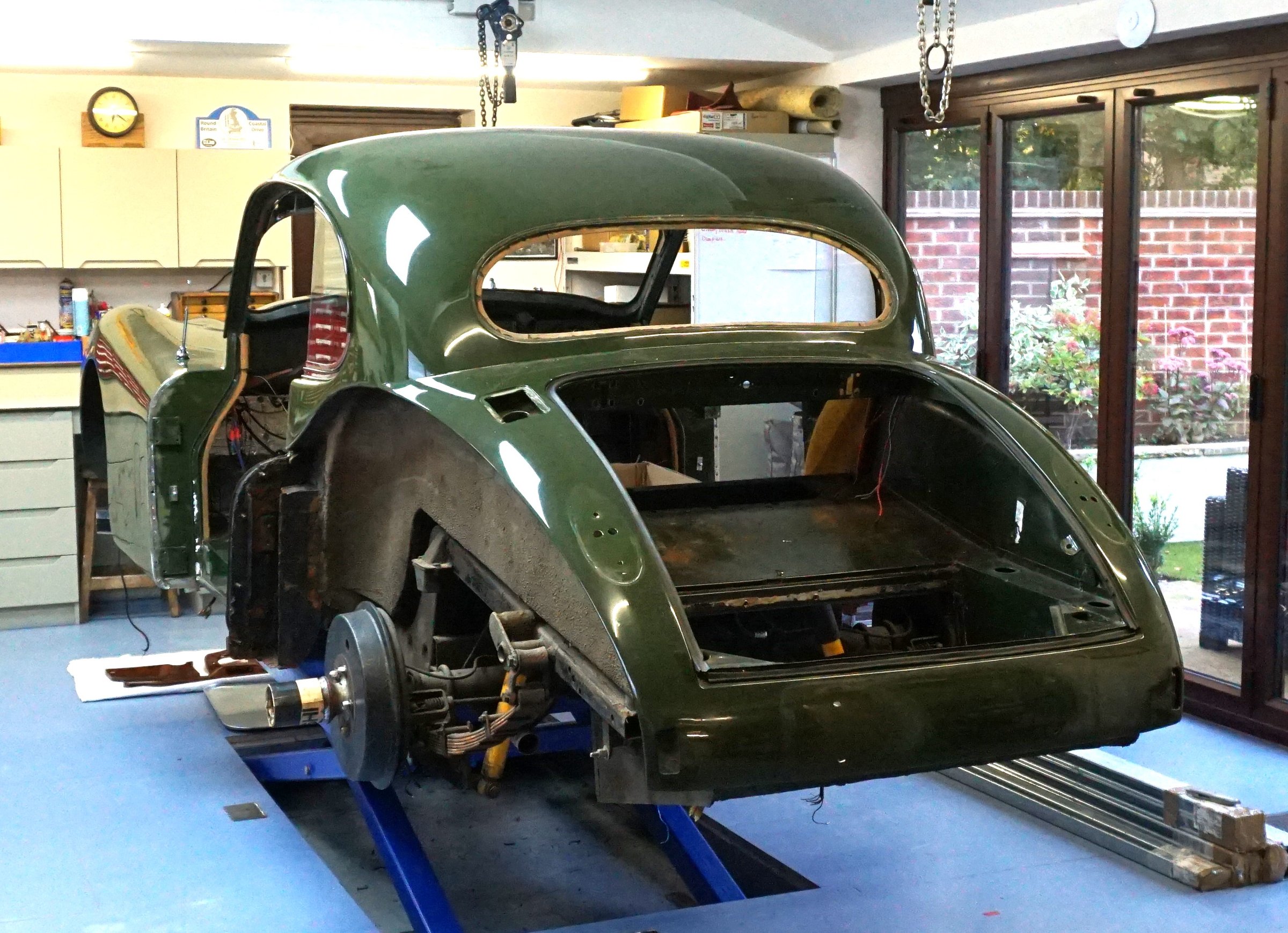
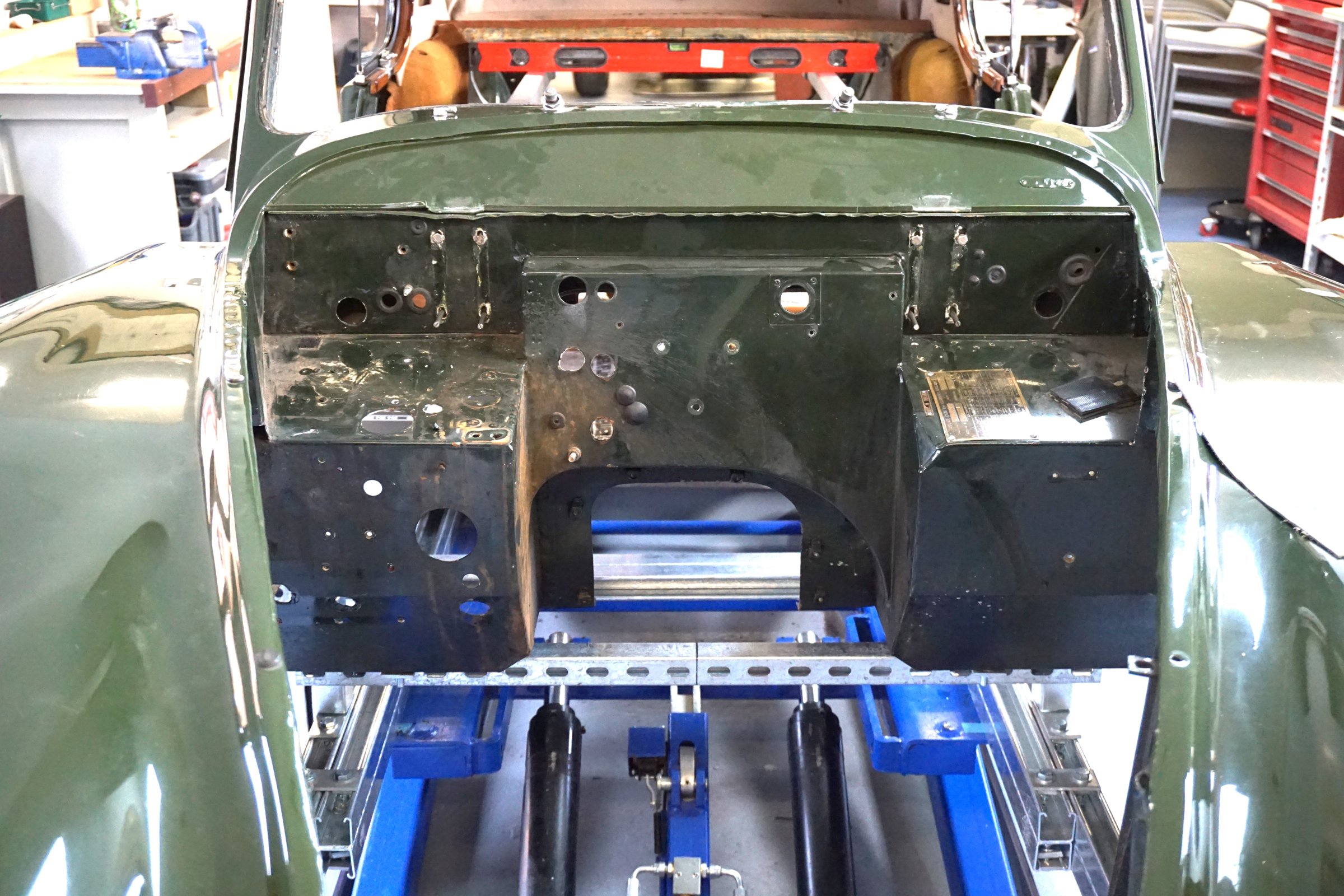
As witnessed by the two pictures above, with the body removed, the chassis was in unbelievably good condition. Considering the ownership history, I would guess that the car has spent most, if not all of its later life garaged and has rarely if ever been used on salty roads.
One find under there was original: a deceleration-activated brake bias device attached inside the chassis rail, almost certainly fitted by Coombs as part of the car's option package when new.
The chassis was media blasted to bare metal by a local firm specialising in metal protection for the offshore oil rig industry, and given that industry's primer as its first coat, then 3M Schutz, then satin black.
The paint specification
The third classic Jaguar the same painter had done for him, and the instructions were detailed. British Racing Green over the body and every inner panel, 2K clear over base — then flatted and polished back to reduce the gloss, because a modern finish looks wrong on a 1955 car. All seams washed in or beaded. Fine stone guard in body colour inside the door panels, door bottoms, wing bottoms, inner wings, the underside body panels at the rear and inside the headlamp pods.
Photographs
- 11 August 2009
- 16 February 2013
- 3 October 2017
- 15 January 2018
- 28 January 2018
- 11 March 2018
- 11 March 2018
- 16 April 2018
- 28 April 2018
- 1 May 2018
- 4 May 2018
- 14 June 2018
- 25 June 2018
- 10 August 2018
- 28 August 2018
- 28 August 2018
- 28 September 2018
- 4 April 2019
- 23 January 2020
- 26 February 2020
- 23 June 2021
- 23 June 2021
- 23 June 2021
- 7 July 2021
- 19 January 2026
- 22 January 2026
- 23 January 2026
- 9 February 2026
- 9 February 2026